Buy erlebnispaedagogik.eu ?
We are moving the project
erlebnispaedagogik.eu .
Are you interested in purchasing the domain
erlebnispaedagogik.eu ?
domain@kv-gmbh.de · 0541-91531010
Buy erlebnispaedagogik.eu ?
What is the power notation in radical notation?
The power notation in radical notation is a way of expressing a number raised to a certain power using a radical symbol. For example, the expression "x^2" in power notation can be written as "√x" in radical notation. This notation is useful for representing square roots, cube roots, and other higher order roots of a number. It provides a way to express exponentiation in terms of roots, making it easier to understand and work with certain mathematical operations. **
How can I convert the summation notation into product notation in mathematics, and how can I convert the product notation into summation notation?
To convert summation notation into product notation, you can use the fact that the product of a sequence of numbers is equivalent to the exponential of the sum of their logarithms. This means that if you have a summation notation like Σ(i=1 to n) of a_i, you can convert it to a product notation by writing it as Π(i=1 to n) of e^(ln(a_i)). Conversely, to convert product notation into summation notation, you can use the fact that the sum of a sequence of numbers is equivalent to the logarithm of their product. So if you have a product notation like Π(i=1 to n) of a_i, you can convert it to a summation notation by writing it as Σ(i=1 to n) of ln(a_i). **

Similar search terms for Notation
Top-Angebote
Products related to Notation:
-
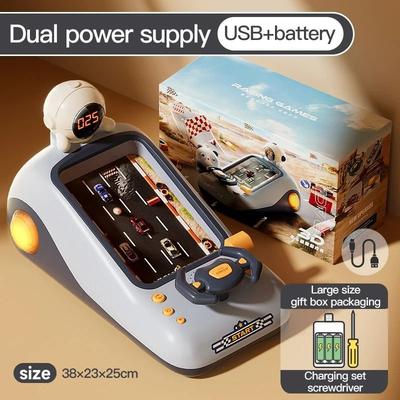
Uplift Picks Kids Steering Wheel Toy Racing Simulation Adventure Learning Game Kids Steering Wheel Toy Racing Simulation Adventure Learning GameLet little drivers take the wheel with this exciting kids steering wheel toy designed for immersive pretend play. This engaging racing simulation toy for children brings lights, sounds, and interactive challenges together for a realistic driving...210,00 $*Shipping: 0,00 $Secure redirect to the provider
-
Learning Resources Stem Explorers Brainometry Game for Kids - Ages 5 and Above - Develops STEM Skills - Imaginative Play, Problem-Solving, TeamworkUnleash your child's creativity and critical thinking skills with the Learning Resources Stem Explorers Brainometry Game. This engaging game invites young minds to tackle exciting challenges while building essential STEM skills in a fun and interactive way. Designed for children aged 5 and above, the game promotes imaginative play, problem-solving skills, and teamwork. Kids will love constructing 3D designs using colorful, interlocking pieces that spark their creativity. Each challenge encourages logical thinking as players figure out how to create their structures. Perfect for group play, the Brainometry game fosters collaboration and communication among friends and family. It's an educational tool that makes learning exciting and entertaining.15,14 £*Shipping: 3,95 £Secure redirect to the provider
-
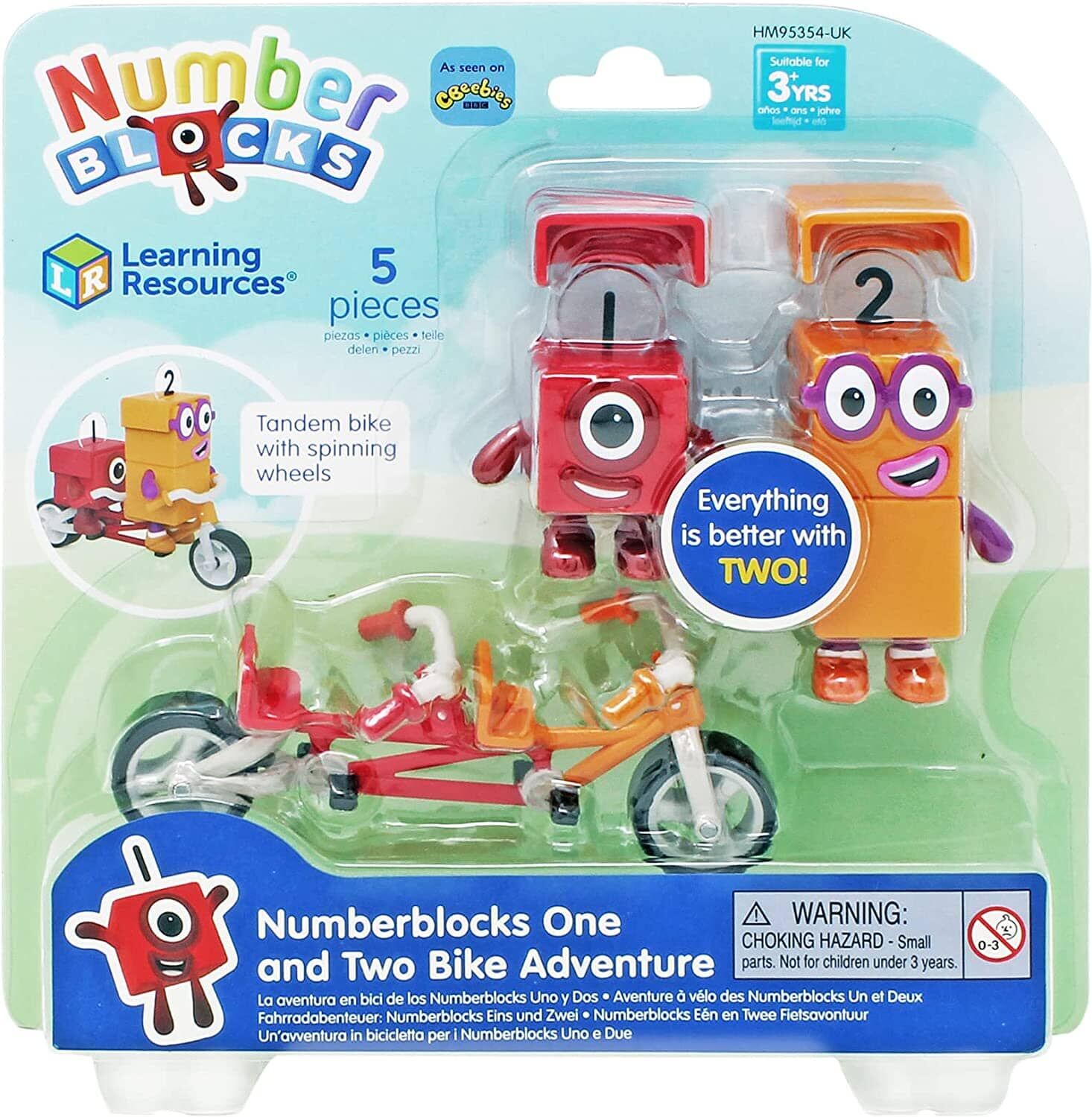
Numberblocks One and Two Bike Adventure by Learning Resources - Ages 3 years+ - Educational Toy Learning ResourcesNUMBERBLOCKS AS SEEN ON TV: The world of Numberblocks comes to life as children create their own Numberblocks adventures at home with Numberblocks One and Two collectible figures, based on the award-winning TV series. INCLUDES TANDEM BIKE & ACCESSORIES: One and Two have their own helmets which they wear as they ride together on their tandem bike on play-filled adventures in Numberland - because everything is better with two! POSABLE ARMS: Move their arms and play or stand them up on display – these fun friends are ready for imaginary play adventures in Numberland. MORE TO EXPLORE: There are even more official Numberblocks collectible figures from Learning Resources ready for children to create their own adventures in Numberland (sold separately). Collect them all! INCLUDES: Numberblocks One and Two with helmets, and tandem bike with turning wheels. (5 Pieces) One measures 5.5cm H.10,99 £*Shipping: 2,99 £Secure redirect to the provider
-
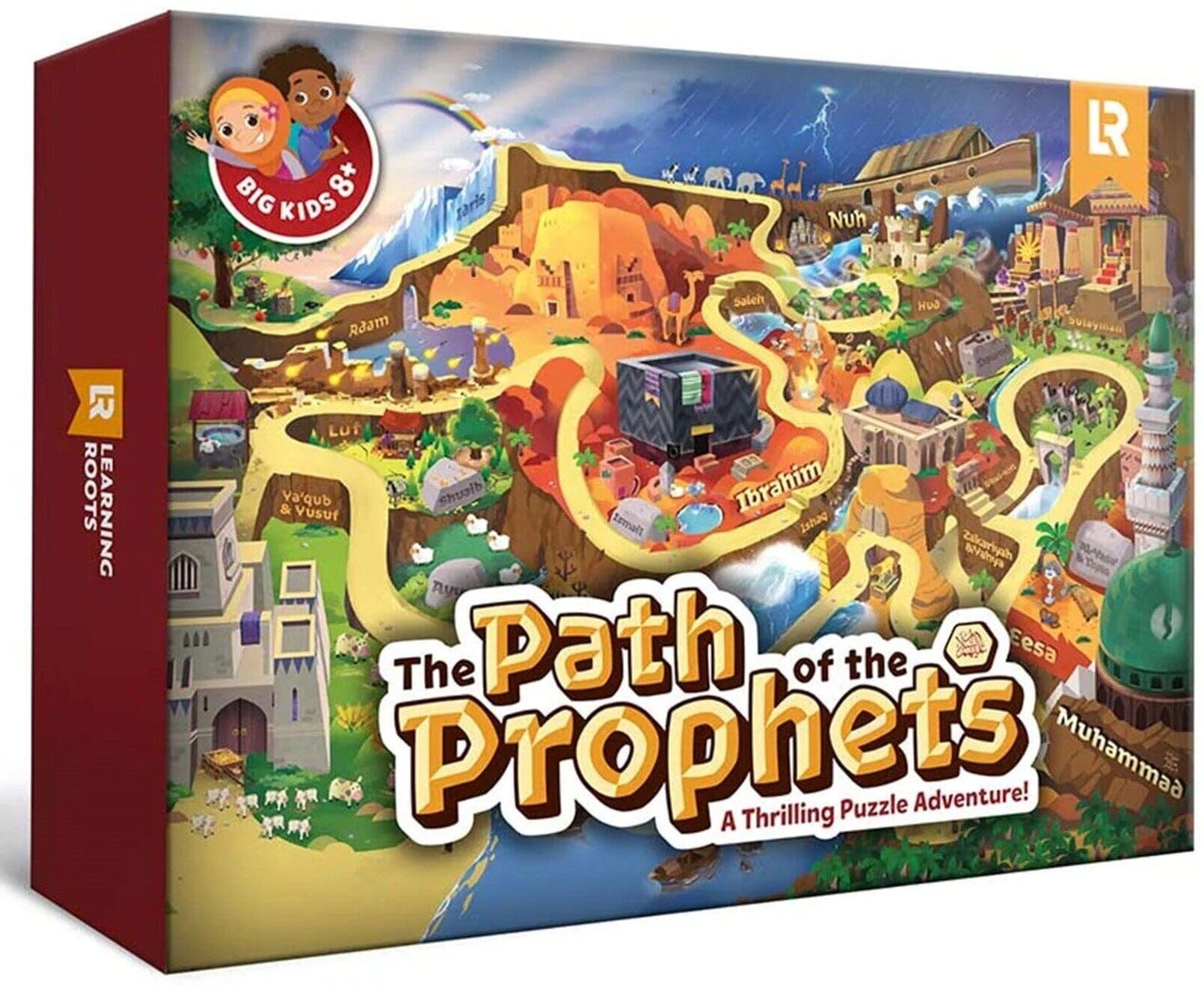
The Path of the Prophets: A Thrilling Puzzle Adventure by Learning Roots Publishing - Ages 8+ Learning RootsThe Path of the Prophets captures the stories of Allah's Messengers and Prophets with stunning visuals laced together in one awe-inspiring map. Discover the highlights from the timeless tales and adventures of the chosen Prophets of Allah. Each Prophet has an image relating to a highlight from their story so your child builds an immediate mental association for better long-term memory. There is a pathway that helps your child learn the order in which the Prophets were sent. It’s an all-in-one story image that sticks in your child’s mind as it is visually engaging which helps them remember the Prophets in a fun way.17,49 £*Shipping: 2,99 £Secure redirect to the provider

-
What is the notation of a permutation in cycle notation?
In cycle notation, a permutation is represented as a product of disjoint cycles. Each cycle is written in parentheses, with the elements of the cycle listed in order. For example, the permutation (123)(45) represents a permutation that maps 1 to 2, 2 to 3, 3 to 1, 4 to 5, and 5 to 4. The cycles are disjoint, meaning they do not share any elements. **
-
What is the difference between exponential notation and scientific notation?
Exponential notation is a general way of representing a number as a base raised to an exponent, where the base is any real number and the exponent is an integer. Scientific notation is a specific form of exponential notation used to represent very large or very small numbers, where the base is a number between 1 and 10 and the exponent is an integer. In scientific notation, the number is written as the product of the base and 10 raised to the exponent, while in exponential notation, the base can be any real number. **
-
How do you prove the big O notation and theta notation?
To prove the big O notation, you need to show that there exists a constant c and a value n0 such that for all n greater than or equal to n0, the function f(n) is less than or equal to c*g(n), where g(n) is the upper bound function. This demonstrates that f(n) is bounded above by g(n) for sufficiently large n. To prove the theta notation, you need to show that there exist constants c1, c2, and n0 such that for all n greater than or equal to n0, c1*g(n) <= f(n) <= c2*g(n), where g(n) is the tight bound function. This demonstrates that f(n) is both bounded above and below by g(n) for sufficiently large n. **
-
How are quadratic equations represented in set notation and interval notation?
Quadratic equations can be represented in set notation as the set of all solutions to the equation. For example, the set notation for the quadratic equation x^2 - 4 = 0 would be {x | x = 2 or x = -2}. In interval notation, the solutions to the quadratic equation can be represented as intervals on the real number line. For the same example, the interval notation would be (-2, 2). This indicates that the solutions to the equation are all real numbers between -2 and 2, including -2 and 2. **

What is set notation?
Set notation is a way of representing a collection of elements or objects within curly braces {}. It is commonly used in mathematics to define and describe sets. Set notation typically includes listing the elements of a set, using ellipses to show a pattern, or using set builder notation to describe the properties that the elements must satisfy to be included in the set. It provides a concise and standardized way to communicate the contents and characteristics of a set. **
What is arrow notation?
Arrow notation is a way of representing the growth rate of a function in mathematics. It uses arrows (such as ->, -->, or --->) to indicate the rate at which a function grows as its input increases. For example, f(n) = O(n^2) means that the function f grows no faster than n^2 as its input n increases. Arrow notation is commonly used in the analysis of algorithms to describe their time complexity and performance. **
Top-Angebote
Products related to Notation:
-
Just Play Slinky Challenge Game for 4 Players - Ages 6+ Teamwork Game with Colorful BeltsGet ready to wiggle, twist and race with the Slinky Challenge Game—a hilarious team game that turns the classic Slinky toy into an energetic four-player showdown. Players split into two teams of two, strap on the colour-matching belts and stretch a Slinky between their waists. The aim is to move a disc along the Slinky using hip movements and teamwork alone. Hands are not allowed, so success depends on coordination, rhythm, and plenty of amusing moves. Race side by side to the finish and see which team can master the challenge first. This active game is ideal for family gatherings, game nights, and any occasion where you want to get everyone moving. It combines the nostalgic appeal of the Slinky with a silly, competitive challenge that can be enjoyed by children, older players, and adults alike. To play, form two teams of two, attach the belts, place a disc on each Slinky, and get ready to shimmy. Work together to move the disc along the Slinky and be the first team to reach the finish line.10,79 £*Shipping: 3,95 £Secure redirect to the provider
-
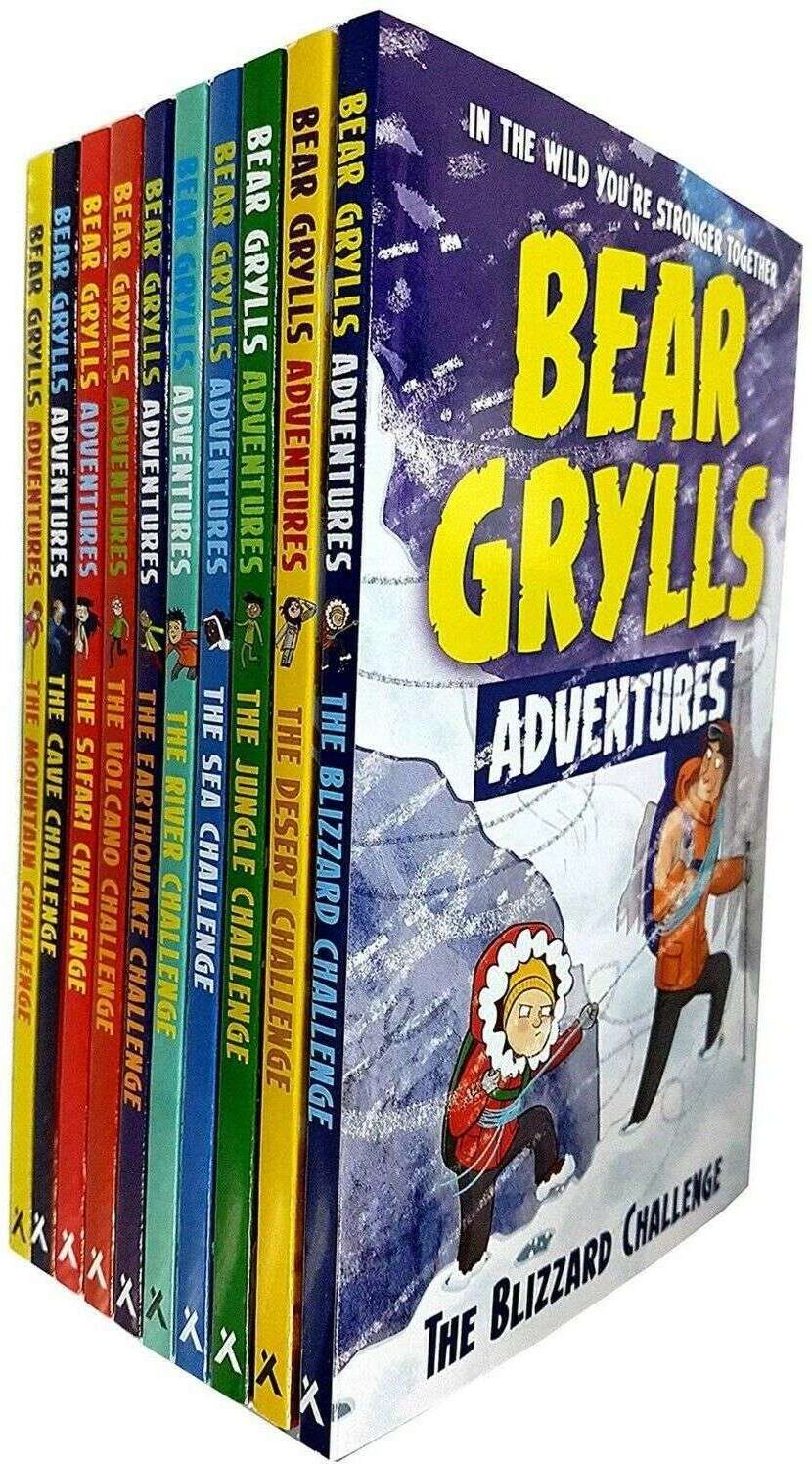
Bear Grylls Adventure Collection 10 Books Set - Blizzard Challenge Desert Challenge Jungle Challen..The Bear Grylls Adventure Collection 10 Books Set Description The Blizzard Challenge Olly isn't enjoying activity camp. Why should he bother building a shelter or foraging for food with his teammates - he'd rather be at home in the warm and dry; where the sofa and the video games are. The Desert Challenge Sophie loves activity camp . . . but is terrified of insects. It's so bad that she won't go into the tent on her own; just in case something flies at her; or she steps on a creepie- crawlie. But when she's given a compass by one of the other boys on the campsite; Sophie is magically transported to the desert on an adventure where they're impossible to avoid! The Jungle Challenge Omar is fiercely competitive and very impatient about anything that holds him back. . . especially other people. Activity camp is brilliant because he's the best at all the challenges; it's just so annoying that not all his teammates are as quick or brave or strong as he is. It would be much easier just to ditch them and go it alone. The Sea Challenge Chloe is enjoying activity camp and all the outdoor fun - what's not to like? But she can't understand why everyone goes on and on about 'leaving things the way you found them'. After all; what's the big deal about a bit of litter in the middle of the woods? The world is big enough for a bit of rubbish not to matter. The River Challenge Anything that means he might have to swim and Jack is the first to duck out of it. But when he falls into a small stream at Camp; he's not just embarrassed - he's been transported to a raging river where dangers lurk around every bend. Luckily; the inspirational adventurer Bear Grylls is there to guide him through the treacherous waters and give him back some of his lost confidence... The Earthquake Challenge Fatima's loving Camp during the daytime; but pitch-black nights in the tent are scary. Then she's given a mysterious compass that transports her to a deserted city; where the aftershocks of a huge earthquake are still being felt and all the lights are out - and the buildings are falling down around her. But soon Fatima meets up with survival expert Bear Grylls; who helps her get safely out of the danger zone. Together they discover that the city's not quite as deserted as it seemed . . . and Fatima learns a few things about staying calm no matter what happens. The Volcano Challenge Charlie loves a challenge - he's addicted to video games and an expert at figuring our how to get to the next level. But sometimes the real world can seem a bit dull. Then he finds himself on the slopes of an active volcano; with red-hot lava heading his way! There's no time to be bored with Bear as his guide out of danger . . . The Safari Challenge Evie likes new experiences - except for being extremely fussy about what she eats. Suddenly she finds herself on a sun-baked safari with Bear Grylls; where food and water are scarce and dangerous wild animals prowl the plains. To survive; Evie must eat...13,48 £*Shipping: 2,99 £Secure redirect to the provider
-
Uplift Picks Kids Steering Wheel Toy Racing Simulation Adventure Learning Game Kids Steering Wheel Toy Racing Simulation Adventure Learning GameLet little drivers take the wheel with this exciting kids steering wheel toy designed for immersive pretend play. This engaging racing simulation toy for children brings lights, sounds, and interactive challenges together for a realistic driving...210,00 $*Shipping: 0,00 $Secure redirect to the provider
-
Learning Resources Stem Explorers Brainometry Game for Kids - Ages 5 and Above - Develops STEM Skills - Imaginative Play, Problem-Solving, TeamworkUnleash your child's creativity and critical thinking skills with the Learning Resources Stem Explorers Brainometry Game. This engaging game invites young minds to tackle exciting challenges while building essential STEM skills in a fun and interactive way. Designed for children aged 5 and above, the game promotes imaginative play, problem-solving skills, and teamwork. Kids will love constructing 3D designs using colorful, interlocking pieces that spark their creativity. Each challenge encourages logical thinking as players figure out how to create their structures. Perfect for group play, the Brainometry game fosters collaboration and communication among friends and family. It's an educational tool that makes learning exciting and entertaining.15,14 £*Shipping: 3,95 £Secure redirect to the provider
-
What is the power notation in radical notation?
The power notation in radical notation is a way of expressing a number raised to a certain power using a radical symbol. For example, the expression "x^2" in power notation can be written as "√x" in radical notation. This notation is useful for representing square roots, cube roots, and other higher order roots of a number. It provides a way to express exponentiation in terms of roots, making it easier to understand and work with certain mathematical operations. **
-
How can I convert the summation notation into product notation in mathematics, and how can I convert the product notation into summation notation?
To convert summation notation into product notation, you can use the fact that the product of a sequence of numbers is equivalent to the exponential of the sum of their logarithms. This means that if you have a summation notation like Σ(i=1 to n) of a_i, you can convert it to a product notation by writing it as Π(i=1 to n) of e^(ln(a_i)). Conversely, to convert product notation into summation notation, you can use the fact that the sum of a sequence of numbers is equivalent to the logarithm of their product. So if you have a product notation like Π(i=1 to n) of a_i, you can convert it to a summation notation by writing it as Σ(i=1 to n) of ln(a_i). **
-
What is the notation of a permutation in cycle notation?
In cycle notation, a permutation is represented as a product of disjoint cycles. Each cycle is written in parentheses, with the elements of the cycle listed in order. For example, the permutation (123)(45) represents a permutation that maps 1 to 2, 2 to 3, 3 to 1, 4 to 5, and 5 to 4. The cycles are disjoint, meaning they do not share any elements. **
-
What is the difference between exponential notation and scientific notation?
Exponential notation is a general way of representing a number as a base raised to an exponent, where the base is any real number and the exponent is an integer. Scientific notation is a specific form of exponential notation used to represent very large or very small numbers, where the base is a number between 1 and 10 and the exponent is an integer. In scientific notation, the number is written as the product of the base and 10 raised to the exponent, while in exponential notation, the base can be any real number. **
Similar search terms for Notation
-
Numberblocks One and Two Bike Adventure by Learning Resources - Ages 3 years+ - Educational Toy Learning ResourcesNUMBERBLOCKS AS SEEN ON TV: The world of Numberblocks comes to life as children create their own Numberblocks adventures at home with Numberblocks One and Two collectible figures, based on the award-winning TV series. INCLUDES TANDEM BIKE & ACCESSORIES: One and Two have their own helmets which they wear as they ride together on their tandem bike on play-filled adventures in Numberland - because everything is better with two! POSABLE ARMS: Move their arms and play or stand them up on display – these fun friends are ready for imaginary play adventures in Numberland. MORE TO EXPLORE: There are even more official Numberblocks collectible figures from Learning Resources ready for children to create their own adventures in Numberland (sold separately). Collect them all! INCLUDES: Numberblocks One and Two with helmets, and tandem bike with turning wheels. (5 Pieces) One measures 5.5cm H.10,99 £*Shipping: 2,99 £Secure redirect to the provider
-
The Path of the Prophets: A Thrilling Puzzle Adventure by Learning Roots Publishing - Ages 8+ Learning RootsThe Path of the Prophets captures the stories of Allah's Messengers and Prophets with stunning visuals laced together in one awe-inspiring map. Discover the highlights from the timeless tales and adventures of the chosen Prophets of Allah. Each Prophet has an image relating to a highlight from their story so your child builds an immediate mental association for better long-term memory. There is a pathway that helps your child learn the order in which the Prophets were sent. It’s an all-in-one story image that sticks in your child’s mind as it is visually engaging which helps them remember the Prophets in a fun way.17,49 £*Shipping: 2,99 £Secure redirect to the provider
-
DynamicDeals Ultimate Family Outdoor Twister Game Mat Interactive Balance & Party Challenge Ultimate Family Outdoor Twister Game Mat Interactive Balance & Party ChallengeGet everyone off the couch and laughing together with the twister game that turns any moment into unforgettable fun. This versatile, fullbody activity mat brings kids, teens, and adults into a playful challenge that blends movement with excitement....34,97 $*Shipping: 0,00 $Secure redirect to the provider
-
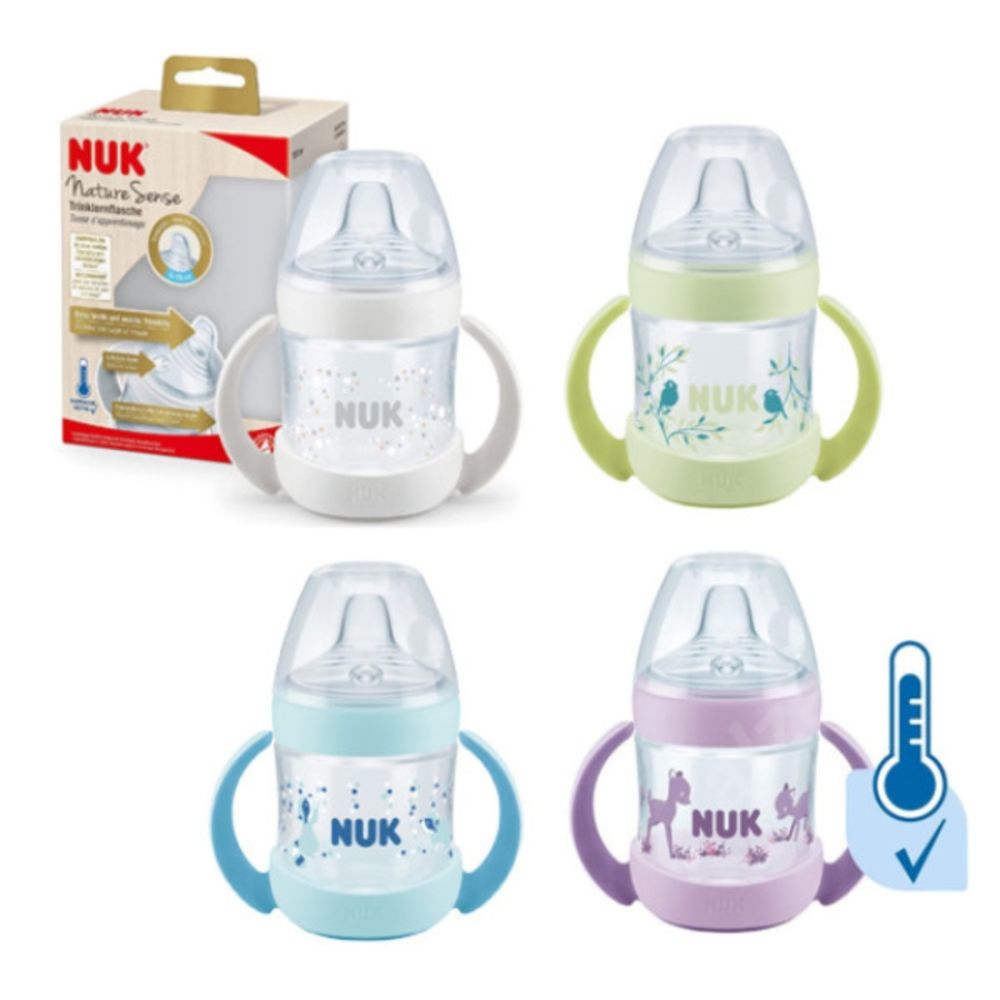
Nuk Nature Sense Learning Bottle for Babies 150mL Assorted Color 6-18mA skin-care product. This product was developed for a natural transition between breastfeeding and autonomy. The bottle indicated for the moment of autonomy. With an extra soft and wide nozzle that transmits to babies a natural feeling of drinking. An optimised anti-colic valve that allows for suction without pauses - avoids air intake, minimizing colics.11,64 £*Shipping: 5,16 £Secure redirect to the provider
-
How do you prove the big O notation and theta notation?
To prove the big O notation, you need to show that there exists a constant c and a value n0 such that for all n greater than or equal to n0, the function f(n) is less than or equal to c*g(n), where g(n) is the upper bound function. This demonstrates that f(n) is bounded above by g(n) for sufficiently large n. To prove the theta notation, you need to show that there exist constants c1, c2, and n0 such that for all n greater than or equal to n0, c1*g(n) <= f(n) <= c2*g(n), where g(n) is the tight bound function. This demonstrates that f(n) is both bounded above and below by g(n) for sufficiently large n. **
-
How are quadratic equations represented in set notation and interval notation?
Quadratic equations can be represented in set notation as the set of all solutions to the equation. For example, the set notation for the quadratic equation x^2 - 4 = 0 would be {x | x = 2 or x = -2}. In interval notation, the solutions to the quadratic equation can be represented as intervals on the real number line. For the same example, the interval notation would be (-2, 2). This indicates that the solutions to the equation are all real numbers between -2 and 2, including -2 and 2. **
-
What is set notation?
Set notation is a way of representing a collection of elements or objects within curly braces {}. It is commonly used in mathematics to define and describe sets. Set notation typically includes listing the elements of a set, using ellipses to show a pattern, or using set builder notation to describe the properties that the elements must satisfy to be included in the set. It provides a concise and standardized way to communicate the contents and characteristics of a set. **
-
What is arrow notation?
Arrow notation is a way of representing the growth rate of a function in mathematics. It uses arrows (such as ->, -->, or --->) to indicate the rate at which a function grows as its input increases. For example, f(n) = O(n^2) means that the function f grows no faster than n^2 as its input n increases. Arrow notation is commonly used in the analysis of algorithms to describe their time complexity and performance. **
* All prices are inclusive of VAT and, if applicable, plus shipping costs. The offer information is based on the details provided by the respective shop and is updated through automated processes. Real-time updates do not occur, so deviations can occur in individual cases. ** Note: Parts of this content were created by AI.